We introduce classical Greek in Year 8 at my school, teaching the alphabet and transliteration. Year 9 lessons build on this, introducing some Greek nouns and verbs for derivation work as well as continuing to practise writing Greek and transliterating. This means that when GCSE options come around in January of Year 9, students can make informed choices about whether to take classical Greek in Years 10-11. At previous schools, I’ve run taster lessons, but the introduction of Greek in Y8 and the consolidation lessons roughly once a half-term in Y9 seem to be more effective in helping students grasp what Greek is all about.
This year I’ve had the pleasure of teaching a Year Ten Greek class on timetable, after teaching it as a twilight weekly class at my previous school. This has allowed me to think again about how I introduce the alphabet, the definite article, nouns, and verbs, as well as to use some new technological tools at my disposal, such as the Carousel platform, which is superb for vocabulary learning.
We introduce the alphabet with a simple handout (I like the presentation in Peter Barker’s ‘The Greek We Speak’ – a superb book for transliteration and derivation work too). I bring in my calligraphy brush pens, which the students enjoy using to colourfully and repeatedly write the Greek letters in their exercise books. I teach the alphabet alpha-omega the first time, linking to Science and Maths as we go – π, θ, λ – and use platforms such as Blooket to practise letter recognition. We look at the letters which are easy to guess – α, ε, ο – and the letters which are harder to draw – ζ, ξ – and the deceptive letters – ν, ρ. We introduce the smooth and rough breathings at this point, too.
Transliteration then is the focus of Y8 and Y9 – starting with characters from Greek myth, Greek words in use in English, e.g. διαγνωσις and then branching out into their own names (where they discover the Roman alphabet has letters which Greek lacks) and a little foray into celebrity names for a bit of fun.
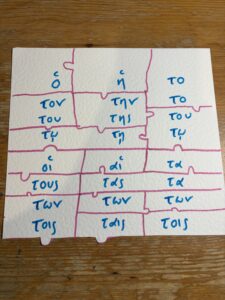
One of the first elements of Greek grammar which is introduced in Year 10, when we move onto John Taylor’s ‘Greek to GCSE 1’, is the definite article. A new activity I brought in this year was a definite article jigsaw: I wrote the definite article out large on sugar paper, cut it out into jigsaw pieces for the students to assemble. They used both their knowledge of the table and the shapes of the pieces to put the table together correctly.
By Christmas of Year Ten, we’ve met active verbs in the present, future, imperfect and aorist. I have παυω written in all 24 forms on flashcards for students to sort into the four tenses, and also translate (the English is written on the back). We also have cards with the present and strong aorist forms of 20 verbs, which the students pair up, e.g., λαμβανω and ἐλαβον.
We’ve also now met approximately 200 words, and one game we invented this term was to pick up two nouns (more flashcards), translate them, and invent a connection between them, e.g. θεα and δωρον – the worshipper gives a gift to the goddess. Next term, we’ll introduce the ‘shopping list’ game: ὁ δουλος τῃ θεᾳ ἀθλον παρεχει (with ἀθλον being added to e.g. και ἱερον).
Table Snippets is an activity I invented for my Greek A-Level class last year. I choose partially completed extracts from definite article, noun and verb tables for the students to complete. They have to recognise the table and complete the missing cells. I do think writing out tables helps with learning endings, but this makes it a little more interesting.
For vocabulary practice, Carousel (www.carousel-learning.com) has been superb. I was introduced to this platform at ResearchEd in 2024, and it’s excellent for retrieval practice and homework. You create question banks through uploading a spreadsheet of words, and then you can make study packs for students to practise at home, and quizzes for testing (with the option of getting them to practise their flashcards before they complete the quiz). There’s also the possibility of doing a ‘whiteboard’ where you do words together on the board. There are all sorts of excellent analytical tools, too, e.g. C-scores for each word to indicate whether this word needs more practice or not.
We have a double afternoon lesson once a fortnight, so we have a culture break halfway through. Topics have ranged from the Amazons to Euripides’ Bacchae (one of my students brought in her copy of Donna Tartt’s ‘Secret History’ so we read an excerpt of that too). This has gone down well, and I’m looking forward to beginning the Literature and Culture component of the OCR GCSE in the Summer Term.
Hopefully, this post has given you a few ideas if you’re teaching a beginner Greek class. I’ll add a second post at Easter with any other new strategies and activities we’ve created from the Spring Term.