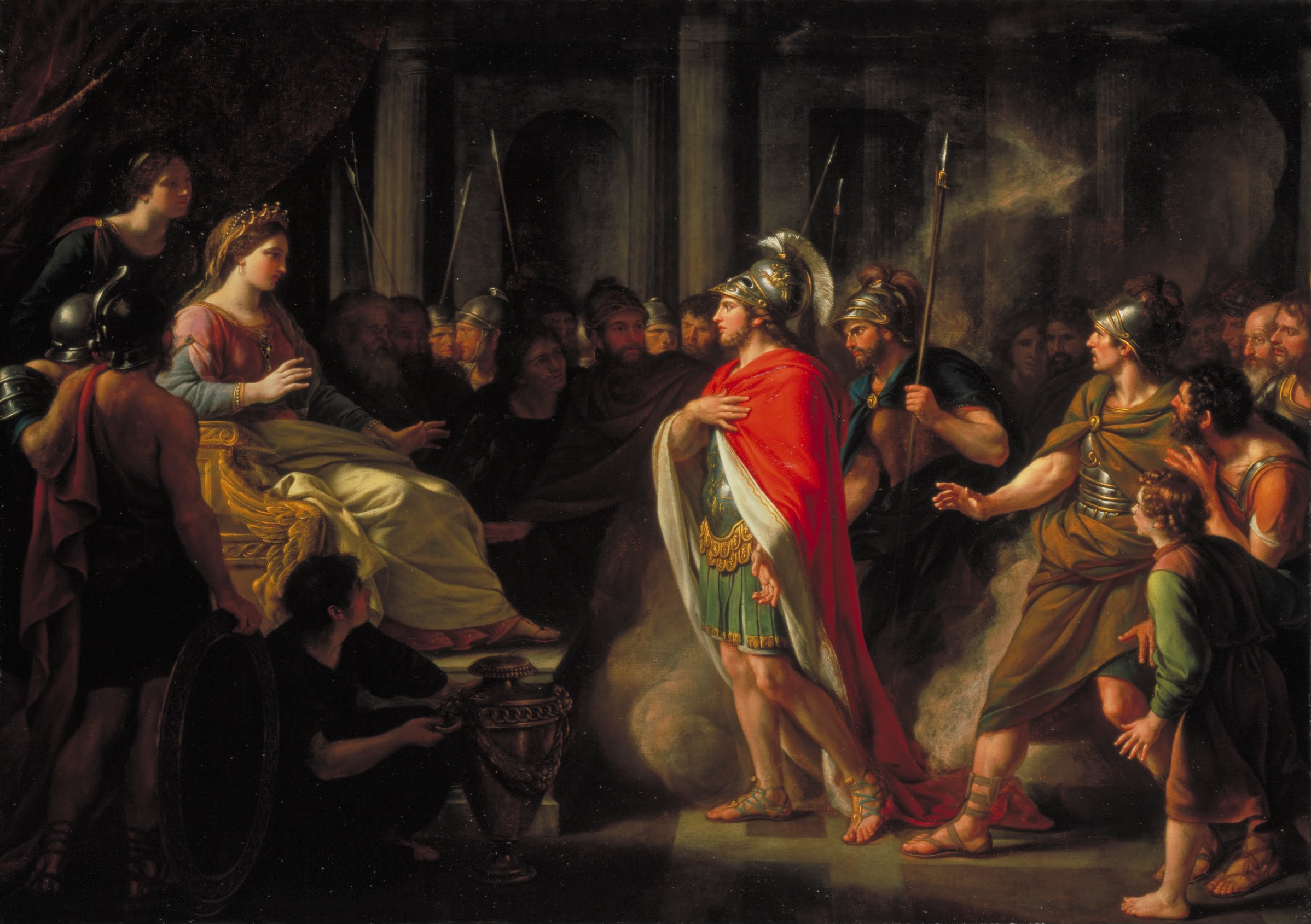
Aeneid 4 – the story of Dido and her tragic love for Aeneas – was my introduction to classical literature in the late 90s, when my teacher, Mr Taylor, taught it to my GCSE Latin class. I loved it from the first line – Dido, the queen of Carthage, wounded by a deep and troubling love for her guest, the Trojan prince, Aeneas. This love was orchestrated by Venus to ensure hospitality for her shipwrecked son (with maybe a little more on her divine agenda, too).
It’s one of the texts that comes round again and again in the OCR set text cycles, so I taught it to my first GCSE Latin class back in 2007 and taught it again this year at A Level. I’ve taught it in translation (David West’s) to the A Level Classical Civilisation class, but I much prefer teaching it in Latin. This year, I prepped and taught a portion I’d not taught in the original before: Dido’s curse upon Aeneas.
We used the Terry Bird running vocabulary (a fantastic resource, if you’ve not used one before) and the Bloomsbury commentary by Storey. I supplemented with the Austin and Williams commentaries too – my go-to Aeneid scholarship since my undergraduate days. I love that Austin reflects on centuries of scholarship, e.g., before Dido delivers her second speech to Aeneas, he tells us that Charles James Fox believed it to be ‘perhaps the finest thing in all poetry’. He also gives a wonderful summary of Dido’s final speech, saying that it ‘must surely rank with the most magnificent of any poet in any language’.
We explored Virgil and the story of Dido beyond the Aeneid, too. We listened to extracts of Purcell’s opera, ‘Dido and Aeneas’. Purcell’s Dido is quite different to Virgil’s – the same unsettling love at the start, but her enjoinder to ‘remember me, but forget my fate’ is very different to Virgil’s heroine, who bids the Carthaginians, in an act of service to her ashes, rouse up an avenger and pursue the Trojans and their Roman descendants with bitter hatred in the centuries to come. Purcell also replaces Venus and Juno as divine agents of Dido’s tragedy, with a sorceress and witches – this is, after all, the time of the first wave of witch trials in England. I prefer the complexity of the Olympian goddesses, however, who try to outwit each other in agreeing a ‘marriage’ for Dido and Aeneas in a cave. Both, however, cause suffering to their favoured mortal: Dido, who recognises at the end Juno’s involvement, ‘conscia Juno’, will die, and Aeneas, who will see Dido in the Underworld, will grieve bitterly too, ‘prosequitur lacrimis longe et miseratur euntem.’
We also looked at Tennyson’s poem to Virgil, written for the citizens of Virgil
Roman Virgil, thou that singest
Ilion’s lofty temples robed in fire,
Ilion falling, Rome arising,
wars, and filial faith, and Dido’s pyre;
Landscape-lover, lord of language
more than he that sang the “Works and Days,”
All the chosen coin of fancy
flashing out from many a golden phrase;
Thou that singest wheat and woodland,
tilth and vineyard, hive and horse and herd;
All the charm of all the Muses
often flowering in a lonely word;
Poet of the happy Tityrus
piping underneath his beechen bowers;
Poet of the poet-satyr
whom the laughing shepherd bound with flowers;
Chanter of the Pollio, glorying
in the blissful years again to be,
Summers of the snakeless meadow,
unlaborious earth and oarless sea;
Thou that seëst Universal
Nature moved by Universal Mind;
Thou majestic in thy sadness
at the doubtful doom of human kind;
Light among the vanish’d ages;
star that gildest yet this phantom shore;
Golden branch amid the shadows,
kings and realms that pass to rise no more;
Now thy Forum roars no longer,
fallen every purple Cæsar’s dome—
Tho’ thine ocean-roll of rhythm
sound forever of Imperial Rome—
Now the Rome of slaves hath perish’d,
and the Rome of freemen holds her place,
I, from out the Northern Island
sunder’d once from all the human race,
I salute thee, Mantovano,
I that loved thee since my day began,
Wielder of the stateliest measure
ever moulded by the lips of man.
(www.poetryfoundation.org)
This is superb as a summary of Virgil’s achievements, from his Eclogues and Georgics to the Aeneid, and of his command of the Latin language, his handling of the epic metre, and his engagement with Greco-Roman myth. I like the salute to the immortality of Virgil. He could never have imagined that women in Britannia (‘barbarae’ and on an island at the very edge of the world) would be reading his lines 2000 years later.